An Illinois freedom trail
Dublin Core
Title
An Illinois freedom trail
Subject
Underground Railroad tourism
Description
The site focuses on western and southern Illinois sites Quincy, Jacksonville, and Alton, as well as Oakland and Chicago. Note that the site erroneously describes the underground railroad as active after the Civil War. Actually, with the end of the Civil War, and the ratification of the Constitution's Thirteenth Amendment to abolish slavery in 1865, the Underground Railroad ceased its activities that year.
Creator
Illinois Office of Tourism
Publisher
Illinois Office of Tourism
Date
2020
Contributor
Illinois Department of Commerce & Economic Opportunity
Rights
Illinois Department of Commerce & Economic Opportunity
Format
jpeg image
Language
English
Type
website
Identifier
WIUGRR #10
Coverage
Illinois, United States
Text Item Type Metadata
Text
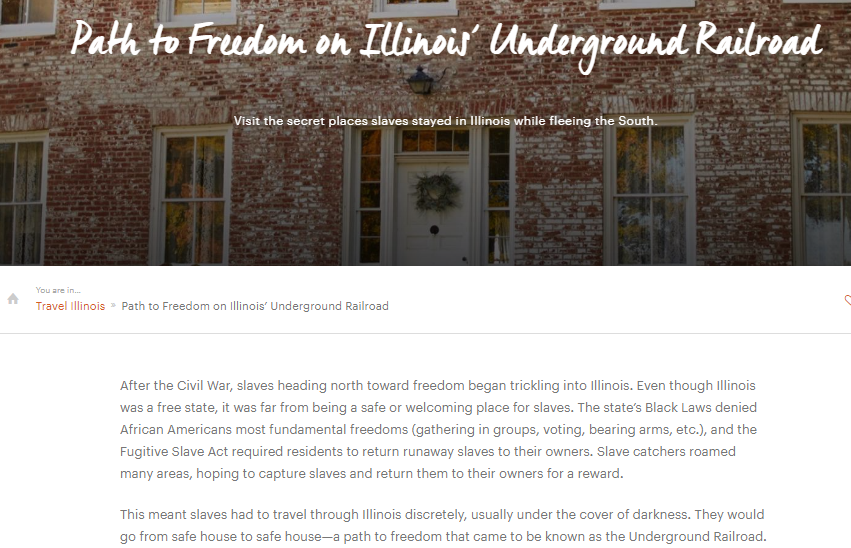
Path to Freedom on Illinois’ Underground Railroad
Visit the secret places slaves stayed in Illinois while fleeing the South.
After the Civil War, slaves heading north toward freedom began trickling into Illinois. Even though Illinois was a free state, it was far from being a safe or welcoming place for slaves. The state’s Black Laws denied African Americans most fundamental freedoms (gathering in groups, voting, bearing arms, etc.), and the Fugitive Slave Act required residents to return runaway slaves to their owners. Slave catchers roamed many areas, hoping to capture slaves and return them to their owners for a reward.
This meant slaves had to travel through Illinois discretely, usually under the cover of darkness. They would go from safe house to safe house—a path to freedom that came to be known as the Underground Railroad.
Visit the secret places slaves stayed in Illinois while fleeing the South.
After the Civil War, slaves heading north toward freedom began trickling into Illinois. Even though Illinois was a free state, it was far from being a safe or welcoming place for slaves. The state’s Black Laws denied African Americans most fundamental freedoms (gathering in groups, voting, bearing arms, etc.), and the Fugitive Slave Act required residents to return runaway slaves to their owners. Slave catchers roamed many areas, hoping to capture slaves and return them to their owners for a reward.
This meant slaves had to travel through Illinois discretely, usually under the cover of darkness. They would go from safe house to safe house—a path to freedom that came to be known as the Underground Railroad.
Original Format
website
Files
Citation
Illinois Office of Tourism, “An Illinois freedom trail,” Traces of Western Illinois' Underground Railroad, accessed October 7, 2026, https://timroberts.org/wiugrr/items/show/10.