Browse Items (24 total)
Sort by:
An Unmarked McDonough County Station
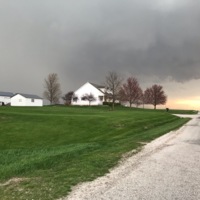
This image shows the modern home and farm buildings on the location of a UGRR station near Macomb, Illinois, "operated" by Harmon Allison, who settled there with his wife Beulah around 1854, once his father William built it. Beulah Brown Allison…
An Illinois freedom trail
The site focuses on western and southern Illinois sites Quincy, Jacksonville, and Alton, as well as Oakland and Chicago. Note that the site erroneously describes the underground railroad as active after the Civil War. Actually, with the end of the…
Abolition City
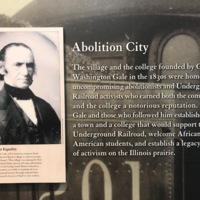
This nickname of Galesburg appears in a permanent exhibition of Knox College's founding and first decades in the era of the Civil War, in the Whitcomb Heritage Center, third floor of Knox College's Alumni Hall.
A U.S. federal list of Illinois sites
The U.S. National Park Service's "Aboard the Underground Railroad" list of recognized Illinois sites
A tombstone in a mixed raced community cemetery
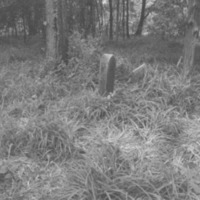
Photograph by the Illinois State Museum of the McWorter or Old Cemetery, where the remains of African American residents of Philadelphia, Illinois were buried. Philadelphia was a village in southwestern Illinois founded in 1836 by Frank McWorter, a…
A Quincy station
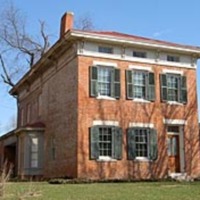
Dr. Richard Eells built this home, Quincy's oldest two-story building, now located within its Downtown Historic District, in 1835, four blocks from the Mississippi River. Quincy, Illinois, was the first Underground Railroad station across the border…
A posthumous pardon
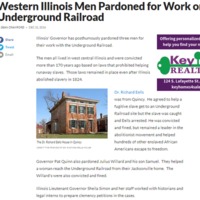
Illinois Governor Pat Quinn pardoned Richard Eells of Quincy and Julius and Samuel Willard of Jacksonville, who in 1843 were convicted of aiding fugitive slaves.
A national underground railroad map
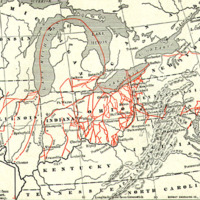
Western Illinois' UGRR routes show prominently in this map, including northeast from Quincy through the Military Tract counties to Princeton, the location of prominent UGRR conductor Owen Lovejoy.
A college's claim to fame
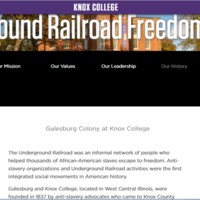
The college's online history emphasizes its founding by opponents of slavery, making Galesburg a regional center of underground railroad activity.
"Negroes" for sale
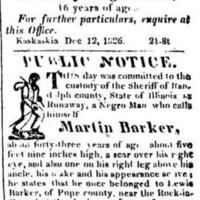
Public notices of availability of two African Americans for purchase, a sixteen-year-old girl, and a forty-three-year-old man. Parallel to the Underground Railroad, there existed a "reverse underground railroad," which, as in this item, targeted…